Endometriosis Whilst Black

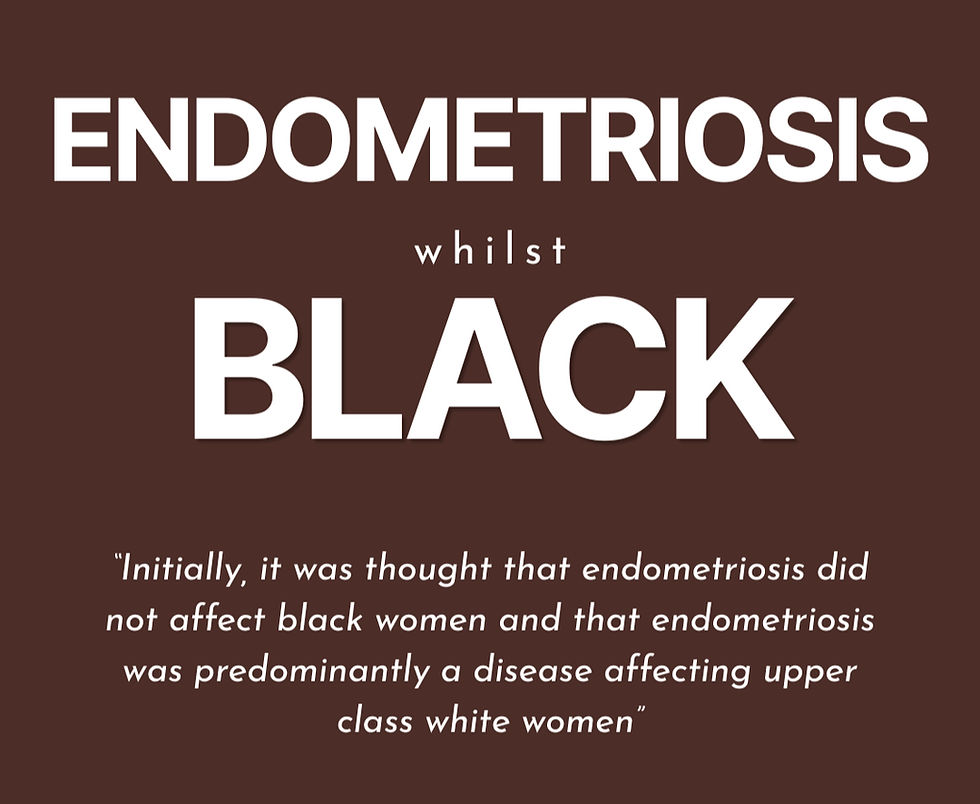
March is endometriosis month, so let's talk about endometriosis

Endometriosis is a chronic condition where the tissue that lines the inside of the womb is found outside the womb, causing symptoms such as pain or infertility.
Endometriosis affects 1 in 10 women of reproductive age, but did you know that black women are 50% less likely to be diagnosed with endometriosis, compared to white women even when they have the same or similar symptoms.
This leads to black women struggling with chronic symptoms with little or no treatment or conditions such as infertility without any solutions for longer periods of time. The average time for diagnosis of endometriosis is 8 - 12 years therefore for black women where symptoms are not always taken into consideration, diagnosis can take even longer.

Initial beliefs about endometriosis Initially, it was thought that endometriosis did not affect black women and that endometriosis was predominantly a disease affecting upper class white women. This was echoed in many medical textbooks therefore likely became accepted as the truth. Whilst race does affect some health conditions, today we know that race has no impact on endometriosis. |
The perception of pain According to a US study, a significant number of student doctors and doctors felt that black people did not feel pain as much as their white counterparts which therefore affected the treatment they received. As a result, in these circumstances black women may not receive the right diagnosis or treatment, especially if black women’s pain is seen as “less than.”
The perception of pain has also been passed down from generation to generation. Our grandmothers and our mothers may have also experienced pain however were told this was normal and just to “manage.” But pain is not normal, so it is important to know when to seek help. |
Fear of treatments Fear of treatments has also impacted our decisions to seek help. Historically, the only solution offered to many women with gynaecological problems was a hysterectomy (removal of the womb).
Realistically and culturally, this is not an option for many women especially if women want to start or expand their families. However solutions are changing and a hysterectomy is now a final rather than a first treatment solution. The narrative is changing. Other options exist therefore don’t be afraid to seek help or seek a second opinion if you are not happy with treatments offered. |

Signs & Symptoms of Endometriosis
Severe period pain
Heavy periods
Pain in the pelvis area
Pain during sex
Pain when you pass stool
Pain when you pass urine
Feeling very tired
Difficulty getting pregnant (in women with infertility, up to 25 - 50% have endometriosis)
Low mood or anxiety
If you have any of these symptoms don’t wait, see your GP. Early diagnosis and treatment is crucial.

There are different methods that are used to diagnose endometriosis
Ultrasound scan (this may involve scanning the tummy or an internal scan, inside your vagina)
MRI scan
Laparoscopy - this is an operation where a camera is passed into the tummy to identify any areas of endometriosis. If it is safe, your gynaecology surgeon may be able to remove areas of endometriosis during this operation.

Endometriosis is treated in a number of ways. The treatments listed here are for information only and should not replace any health or medical advice given to you by your own healthcare professionals. Currently, there is no cure for endometriosis and whilst research continues, treatments can help improve symptoms.
Medications
Medications such as painkillers or hormonal treatments can help to change the amount of hormones in your body, which in turn can help reduce symptoms.
Surgery
An operation may be needed to treat endometriosis. During an operation, the surgeon may be able to see areas of endometriosis and if it is safe, will be able to remove them. In some cases more complex planning of your operation may be required or more than one operation may be needed to treat the endometriosis.
An operation may also be an option if your endometriosis is affecting getting pregnant.
Support
Endometriosis is a chronic condition that currently has no cure therefore finding support either through your village, your tribe, your community as well as organisation such as Endometriosis UK* and The Endometriosis Foundation* can offer more information, support groups and the ability to chat to a nurse to support you through your diagnosis.
*no endorsement

We know how difficult it can be to be listened to and to get the right help. We want you to be able to advocate for yourself in health spaces, so here are a few tips to help you along the way:
Seek Help
If you are experiencing any symptoms of endometriosis, be sure to go to your doctor, especially when you feel something is not right
Get Treatment
Your doctor might suggest a treatment listed above but if these are not working for you, don’t hesitate to go back to your doctor and ask for either a different treatment, a scan or referral to a specialist gynaecology doctor
Symptom Diary
When you go to the doctor, make sure to have a diary of the symptoms you are experiencing. A symptom diary gives you a clearer understanding of what is happening to your body and also means that your doctor will have a better idea of the right treatment for you
Your symptom diary should include:
- the dates your menstrual cycle begins and ends
- pain severity during your menstrual cycle and at other times of the month
- how heavy your bleeding is (for example how often are you changing pads, do you soak through pads or clothing, do you have to use both tampons / menstrual cup and sanitary towels)
- any pain when you wee or poo
- do you have any other symptoms such as tummy bloating, constipation or frequent urination
- is sex painful
- does anything make your pain better or worse
Don’t do it alone
Getting the right diagnosis and treatment may require a village. If you feel comfortable attend, appointments with a trusted relative, friend or colleague. There may be times when you cannot speak up for yourself therefore this support can act as your voice during appointments and whilst navigating your health. You don’t have to walk the pathway alone
Seek a Second Opinion
Don’t be afraid to ask for a second opinion - after all, certain doctors may have more experience in endometriosis therefore might be able to suggest more appropriate treatments for you
Knowledge is Power
Once you are diagnosed with endometriosis, don’t be afraid to ask where your endometriosis is located, what long term symptoms you may experience and how endometriosis might impact your future (for example your fertility plans)
Get Involved
Much more research is required into endometriosis which will not only help
yourself but your family members too. Research not only involves being in the lab, but also learning about endometriosis, supporting organisations working with endometriosis / women’s health and not being afraid to get help for your endometriosis.

Sources
Endometriosis: black women continue to receive poorer care for the condition
www.medsci.ox.ac.uk/news/endometriosis-black-women-continue-to-receive-poorer-care-for-the-condition
Revisiting the impact of race/ethnicity in endometriosis
Racial bias in pain assessment and treatment recommendations, and false beliefs about biological differences between blacks and whites
https://pmc.ncbi.nlm.nih.gov/articles/PMC4843483/
Endometriosis
Endometriosis Facts and Figures


Comments